

Ivermectin is a widely used antiparasitic medication in both human and veterinary medicine. Although the same active ingredient is used across different species, its approved uses, formulations, and dosing recommendations vary considerably. This has led to a common misconception that human and veterinary ivermectin products are interchangeable. In reality, they are developed for different medical purposes and should only be used as directed by a healthcare professional or veterinarian.
What Is Ivermectin?
Ivermectin belongs to a class of antiparasitic medications. It works by binding to specific chloride channels found in parasites, disrupting their nerve and muscle function. This causes paralysis and death of susceptible parasites while having minimal effects on humans when used at approved doses
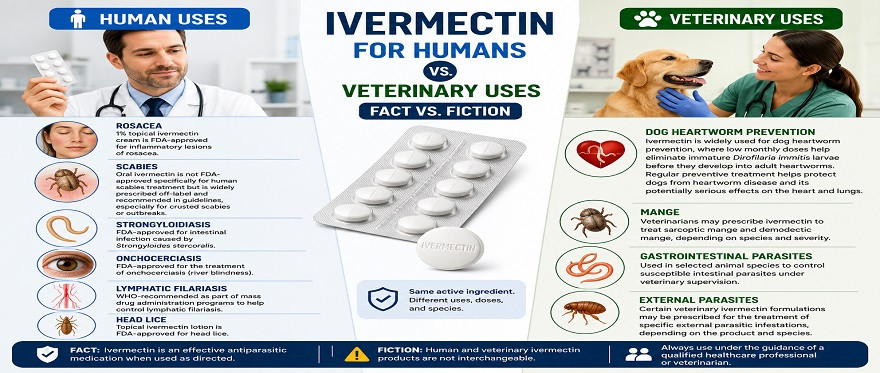
Human Uses of Ivermectin: Fact
The U.S. Food and Drug Administration (FDA) has approved ivermectin for several human conditions, while the World Health Organization (WHO) recommends its use in public health programs for certain parasitic diseases.
Strongyloidiasis
Oral ivermectin is FDA-approved for treating intestinal infection caused by Strongyloides stercoralis, a parasitic roundworm.
Onchocerciasis (River Blindness)
Ivermectin is approved for the treatment of onchocerciasis and is widely used in WHO-led disease control programs to reduce transmission in endemic regions.
Rosacea
A 1% topical ivermectin cream is FDA-approved for treating the inflammatory lesions of rosacea. It helps reduce skin inflammation while targeting microscopic Demodex mites that may contribute to the condition.
Head Lice
Topical ivermectin lotion is approved for treating head lice in adults and children of eligible age.
Scabies
Although oral ivermectin is not FDA-approved specifically for human scabies treatment, it is widely prescribed off-label to treat scabies in certain patients and is recommended in several clinical guidelines, particularly for crusted scabies or outbreaks in institutional settings.
Lymphatic Filariasis
Oral ivermectin is recommended by the WHO as part of mass drug administration programs to help control lymphatic filariasis in endemic regions. It reduces the number of microfilariae circulating in the bloodstream and helps interrupt disease transmission when used in combination with other antiparasitic medications.
Veterinary Uses of Ivermectin: Fact
Ivermectin veterinary use includes the prevention and treatment of several parasitic diseases in animals. The approved indications differ significantly from those in humans, and veterinary products are formulated specifically for animal species.
Dog Heartworm Prevention
Ivermectin is widely used for dog heartworm prevention, where low monthly doses help eliminate immature Dirofilaria immitis larvae before they develop into adult heartworms. Regular preventive treatment helps protect dogs from heartworm disease and its potentially serious effects on the heart and lungs.
Mange
Veterinarians may prescribe ivermectin to treat sarcoptic mange and demodectic mange, depending on the animal species, severity of infestation, and current veterinary guidelines.
Gastrointestinal Parasites
In selected animal species, ivermectin is used to control susceptible intestinal parasites under veterinary supervision.
External Parasites
Certain veterinary ivermectin formulations may also be prescribed for the treatment of specific external parasitic infestations, depending on the approved product labeling and animal species.
Fact vs. Fiction
✔ Fact: Human and veterinary ivermectin contain the same active ingredient.
✘ Fiction: Human and veterinary ivermectin products are interchangeable.
✔ Fact: Human ivermectin is approved for specific medical conditions such as strongyloidiasis, onchocerciasis, rosacea, and head lice, while oral ivermectin is commonly prescribed off-label for certain cases of scabies.
✘ Fiction: Veterinary ivermectin products are safe for human use.
✔ Fact: Veterinary formulations are manufactured in different strengths, dosage forms, and concentrations to meet the needs of different animal species.
✘ Fiction: Taking a higher dose of ivermectin provides better protection against parasites.
Why Human and Veterinary Products Are Different
Although both products contain ivermectin, regulatory approval is based on species-specific safety and effectiveness data. Human medicines undergo clinical evaluation for human diseases, whereas veterinary products are developed for animal health. Dosage calculations, inactive ingredients, and treatment protocols differ substantially, making it unsafe to substitute one product for the other without professional guidance.
Conclusion
Ivermectin plays an important role in both human and veterinary medicine, but its uses are not the same. In humans, it is prescribed for conditions such as strongyloidiasis, onchocerciasis, rosacea, head lice, and, in appropriate clinical situations, scabies. In veterinary medicine, ivermectin veterinary use commonly includes dog heartworm prevention, mange treatment, and the control of certain internal and external parasites. Understanding these differences helps prevent misuse and ensures that ivermectin is used safely and effectively for its intended purpose. Always use ivermectin exactly as prescribed by a qualified healthcare professional or veterinarian.



Validate your login